Lore & World Explained Guide
The lore of Core Keeper is told through ruins, creatures, objects, and fragmentary records rather than a single straight history. Together they sketch a subterranean world that has been inhabited, shaped, abandoned, and reclaimed many times.
The underground as a living world
The underground is not empty wilderness. It is crowded with strange life, old settlements, and traces of civilizations that came before the player.
- The first explorer’s notes describe a world with no sunrise or sunset, where time seems to disappear underground.
- The same journey reveals that what looks like simple danger often escalates into something far larger: slime, mushroom-like beings, giant larvae, and huge insect remains.
- Caves contain evidence that very large creatures once lived there, including enormous empty shells and other oversized insect traces.
- Later notes show that the underground is still active and dangerous far from the starting area, especially in regions tied to advanced automation, ancient ruins, and hidden wildlife.
Ancient people and abandoned places
Many discoveries point to a long-lost underground society or several overlapping ones.
Cavelings and their ruins
The explorer repeatedly encounters Cavelings and their constructions.
- Cavelings are not simple primitives; the notes make it clear they are more advanced than they first appear.
- Ancient stone houses appear in the wilderness, suggesting organized building or the remains of older sites linked to Cavelings.
- Cavelings also appear as guardians of important places, such as the shells and sites in Azeos’ Wilderness.
- A Caveling Hunter is described as using camouflage to hide in grass and surrounding intruders with other Cavelings, implying coordinated defense rather than random hostility.
- One recorded note from the world’s deeper lore suggests the underground has experienced prior attempts at rebuilding society after some kind of destruction.
Ruined laboratories and forgotten science
The explorer also finds abandoned scientific facilities.
- These places contain recycled scientific equipment, abandoned rooms, and objects left behind in a hurry.
- The notes imply the people who worked there fled suddenly.
- One discovery inside these facilities is a mysterious symbol seen more than once, possibly a rune or an ancient writing system.
- The same place contains a strange creature that may be tamable, hinting that underground science did not simply study the world; it may have tried to reshape it.
The great insect threat
Insect life is one of the strongest motifs in the lore.
- Huge larvae pursue intruders the moment torches appear.
- Large insect shells suggest creatures far larger than most underground enemies.
- A later expedition brings the explorer face to face with an enormous buzzing threat that tracks them through the wilderness and is difficult to escape even after explosives and teleportation.
- Another note describes a cyborg-modified Pest, IS-0173-B, combining organic menace with unintended electricity. Its description makes clear that underground life can be altered by technology as well as evolution.
The Shimmering Frontier and the crystal biome
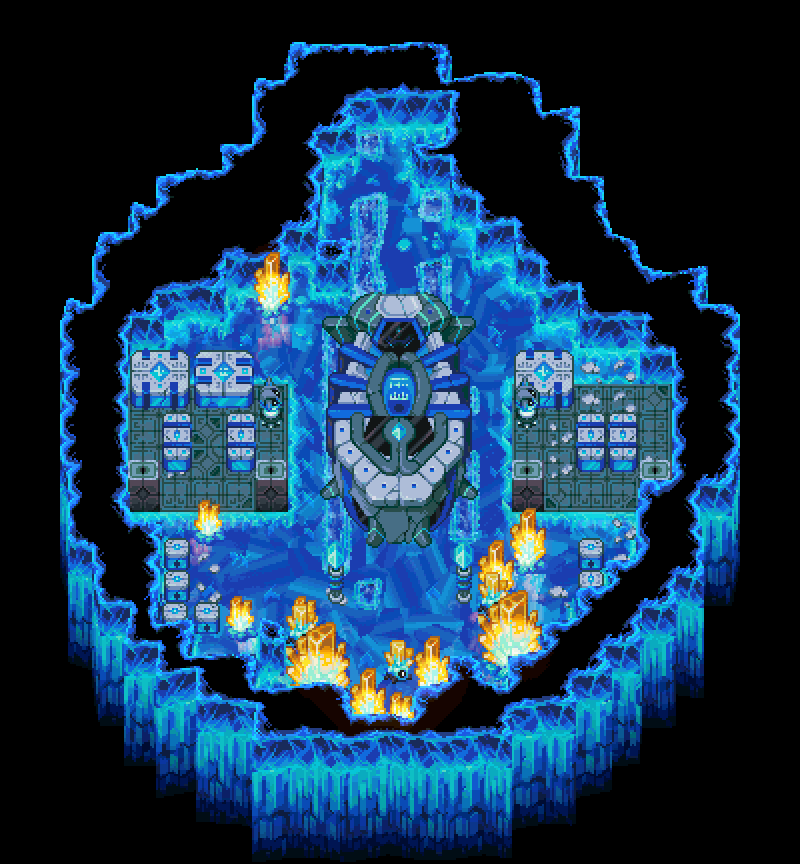
- Before its release, developers used Obsidian Blocks as a placeholder for the region.
- Those placeholder formations grew larger and more common the farther out the player traveled, helping foreshadow the later biome while keeping long-time explorers from needing to travel too far.
This points to a world whose outer reaches were prepared in advance as an expanding mystery, with the Frontier serving as one of the later layers of subterranean civilization and geology.
Creatures as lore clues
Creature descriptions in Core Keeper do more than identify wildlife. They reveal how life adapts to the underground, and how strange and old the ecosystem is.
Familiar animals that still thrive underground
Some creatures are normal animals that have survived in hidden underground habitats.
- The dodo is treated as a species long believed extinct, yet it still thrives underground.

- Goats are stubborn, woolly animals with poor eyesight and a bold temperament.
- Goat babies are curious and playful, chasing butterflies rather than following their parents’ stubborn ways.
- Cows are violet prairie animals that live safely and produce rich milk.
- Baby cows are described as innocent young animals that grow quickly.
- Camels are desert-adapted creatures that produce a potent chemical base, showing how underground ecosystems reach even harsh biomes.
- Camel babies are eager to explore the desert.
Small wildlife and ambient fauna
Many small creatures add to the sense that the underground is a complete ecosystem.
- Blue-purple crabs hold their claws up like a cheerful pose.
- Another crab variant is red and yellow and has the same raised-claw expression.
- A tiny beetle appears in many locations and is currently looking for a new home.
- A desert centipede has an unknown number of legs, simply because counting them would take too long.
- A small scorpion is harmless to humans but deadly to smaller prey.
- A dark newt-like creature seems blind, yet is said to stare deep into your soul.
- A mosquito-like critter frantically flies around trying to find blood.
- A passage-fly drifts through the air with calm motion even in harsh conditions.
- A dream butterfly is said to bring good dreams and is often seen near sleeping creatures.
- A base butterfly has deep red wings and seeks the company of other small creatures.
- A citrus butterfly has bright, irritating colors and flies erratically.
- An icy butterfly beats its wings so fast that it creates cold air currents.
- A blue firefly is said to travel in dancing swarms, with biome-specific blue light.
Underground wildlife with unusual behavior
Other species stand out for their peculiar traits.
- The fluffy goat-like creature is more bold than patient and has poor eyesight, so accidental collisions are part of its nature.
- The dark newt’s description emphasizes an eerie, almost psychic gaze.
- A sandy critter with a happy expression and raised claws fits the broader tone of the underground’s strangely charming fauna.
Encounters, survival, and exploration
The lore also emphasizes how exploration changes the explorer.
- The first notes show a lone wanderer losing track of time underground.
- Later entries show the same person becoming more capable, building automation, setting up a research area, and collecting resources more efficiently.
- The underground encourages adaptation: better weapons, more advanced tools, and careful movement through unknown biomes.
- Even so, the explorer repeatedly encounters threats that force retreat, rescue, or improvisation.
Themes of reconstruction and hidden history
The strongest throughline in Core Keeper lore is that the underground is built on layers of forgotten effort.
- Ancient stones, abandoned labs, mysterious symbols, and oversized remains all suggest prior ages that ended badly or vanished suddenly.
- Cavelings, scientific relics, and creature mutations imply that the underground has never been static.
- Descriptions of bosses and key figures reinforce this tone of a world marked by collapse, rebuilding, and exclusion.
One ancient voice speaks in the language of a restored society, referring to a world erased long ago, mistakes that were made, and a renewed society with no place for outsiders. That framing suggests the underground’s history includes both loss and attempts at renewal.
What the lore says about the underground
Taken together, the lore presents Core Keeper’s underground as:
- ancient but still active
- full of layered civilizations
- rich with strange wildlife
- shaped by both technology and nature
- haunted by ruins, symbols, and unfinished stories
It is a place where every biome adds another piece of history, and every creature description hints that the underground is older, stranger, and more populated than it first appears.
Pages featured in this guide
- itemAdder Stone
- itemAgartha Report
- itemAmber Chunk
- itemAncient Fountain
- itemAncient Hologram Pod
- itemAnteverse Portal
- itemAtlantean Worm Chest
- itemAtlantean Worm Necklace
- itemAtlantean Worm Sword
- itemAzeos Figurine
- itemBeryll Angle Fish
- itemBone Necklace
- itemBone Ring
- itemCaveling Cup
- itemCaveling Prophet Mask
- itemCaveling Skull