Artillery wagon

Overview
The artillery wagon is a train wagon that mounts an artillery piece and can also serve as a dedicated shell carrier. It is designed for long-range bombardment of enemy structures and for moving artillery shells around the rail network. Compared with stationary artillery turrets, it trades some convenience and firing flexibility for mobility and a much larger onboard ammunition store.
In automatic mode, the wagon fires only while the train is stopped at a train stop. It scans for enemy structures such as spawners and worms and attacks them automatically, but it cannot target mobile enemies directly. Shells still damage biters and spitters caught near the impact point, so automatic fire can still clear nearby enemy forces indirectly. Automatic firing does not work while the train is stopped at a red signal, while it is moving, or when the train is stuck in a no-path state. While at a train stop, the wagon’s scanning and shooting count as train activity for schedule departure conditions, and the scan itself proceeds chunk by chunk at one chunk per tick until all chunks in range have been checked.
Manual firing uses an artillery targeting remote to point at any location on the surface or map. Each click fires one shell to the selected position, as long as at least one loaded artillery piece is in range of the cursor. Manual fire can target unexplored terrain as well; the shells reveal every chunk they pass through, though they do not reveal surrounding chunks. A targeting remote also shows how many artillery pieces in range are ready to fire, counting loaded wagons only when they are stationary.
The wagon has a very large range: 224 tiles in automatic mode and 560 tiles in manual mode. Both ranges can be increased by infinite artillery range research, which adds 30% of base range per level. 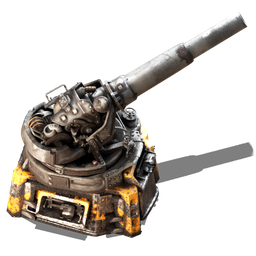
Despite its power, the artillery wagon is not a complete replacement for conventional defenses. Shelling enemy territory provokes nearby mobile enemies into attacking the firing position, so large bombardments can create major counterattacks centered on the wagon’s location. Because of this, an artillery wagon should be protected by walls, gun turrets, laser turrets, flamethrower turrets, or direct player defense, especially when used in a forward position. Its slow firing rate also makes sustained defense dependent on its supporting fortifications.
From a logistics perspective, the wagon is useful because it can carry its own ammunition. Inserters load and unload artillery shells normally, and each wagon holds 100 shells, compared with 15 in an artillery turret and 40 in a regular cargo wagon. This makes the artillery wagon the most space-efficient rail vehicle for transporting shells, though not the most mass-efficient: it weighs as much as 4 regular wagons or 2 locomotives for acceleration purposes, so a shell train built from regular wagons may accelerate and fuel more efficiently if length is not a concern. 