Bridge (Carbon)
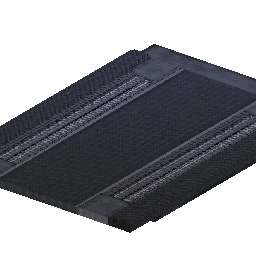
A larger bridge, strong and wide enough for vehicles, with enough structural support.
Overview
Because the design specification centers on width, strength, and structural support, the
Practical considerations and straightforward usage notes:
- Use the
- Install it where reliable structural support is necessary: the bridge design incorporates sufficient supports to carry vehicular weight rather than relying on minimal or improvised foundations.
- Prefer it over smaller or pedestrian bridges when continuity of vehicle routes is critical for logistics, convoys, or supply lines; its larger size reduces the need for multiple parallel crossings.
- Because the bridge is characterized by built-in structural support, it functions as a self-contained solution for spanning gaps where a robust, stable crossing is required rather than a temporary or fragile walkway.
- The
The entry’s localized descriptions uniformly emphasize the same attributes: greater size, vehicle suitability, resistance/strength, width, and dependable structural support. Use
Official description
A larger bridge, strong and wide enough for vehicles, with enough structural support.
Other entities of this type
- ATV
- Bridge (Wood)
- Cloth Rope
- Forklift
- Gaseous Nest
- GATE Security Cart
- GATE SUV
- Hardlight Bridge (Large)
- Hardlight Bridge (Pedestrian)
- Hotwire Kit (Security Cart)
- Hotwire Kit (SUV)
- Jetpack
- Jump Pad
- Landing Cushion
- Long Jump Pack
- Personal Teleporter
- Plant Rope
- Power Chair
- Ramp (Large)
- Ramp (Small)
- Sleigh
- Teleporter Pad
- Tram
- Trampoline