Fill Valve

Overview
The 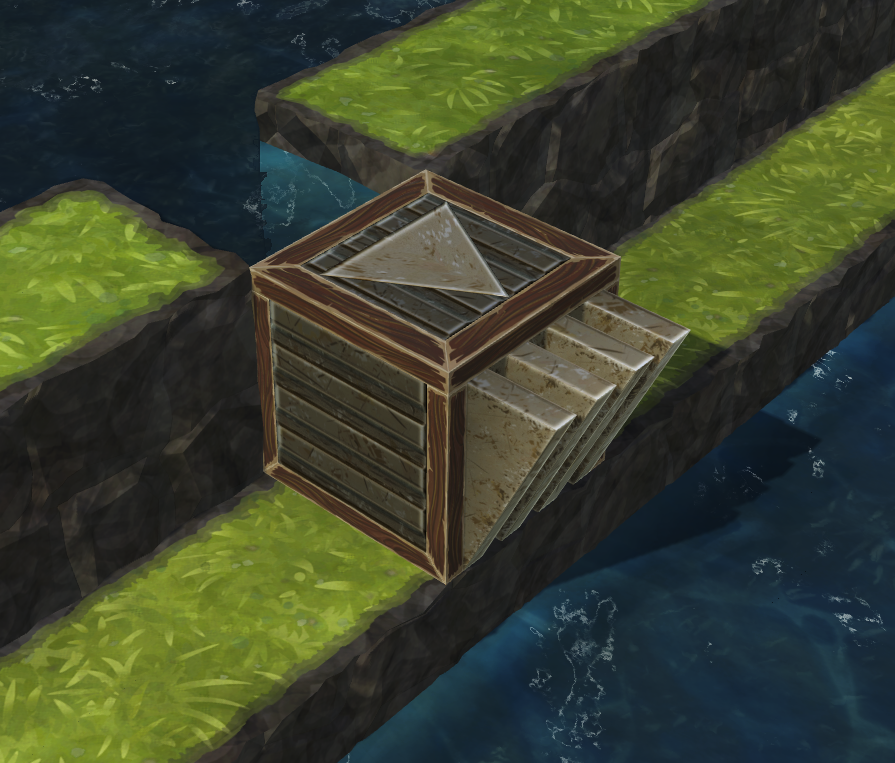 Fill Valve is a fluid-control building that regulates the height of water on its outlet side and can act as a one-way passage when set to unlimited. It is placed in channels or riverbeds to control downstream depth independently of upstream conditions, and it integrates with Timberborn's signal system to switch between two preset outlet heights. Fill Valves are commonly used in sluices, irrigation channels, and to keep riverbeds or basins watered during droughts.
A Fill Valve allows the player to choose an upper target height for the downstream (outlet) fluid measured from the nearest solid surface directly below the outlet. The setting range runs from 0.00 m up to the top surface of the Fill Valve itself. When the downstream depth reaches the set value, the valve stops permitting additional flow from inlet to outlet. Setting a Fill Valve to "Unlimited" disables the height clamp and effectively makes the valve behave as a one-way valve: it permits normal flow from inlet to outlet but prevents flow back from outlet to inlet.
Without a signal source, the Fill Valve exposes a single height control for the downstream depth and an option to let it propagate its setting to adjacent Fill Valves. A common manual configuration is 0.75 m for the downstream target; enabling the adjacent-valve setting lets players quickly apply the same depth across a run of valves.
Connecting a signal source adds a second configuration: the valve uses one outlet-height when the signal is on and a different outlet-height when the signal is off. This allows dynamic control such as opening fully during flood prevention or closing to conserve upstream water. Typical automated setups pair a Fill Valve with a Depth Sensor upstream: configure the Depth Sensor to detect when upstream depth falls below a safety threshold (for example 0.70 m), set the Fill Valve's On slider to 0.75 m and the Off slider to 0.00 m. This preserves upstream supply while trying to maintain the downstream target.
Practical usage notes and interactions:
- A Fill Valve set to a modest downstream depth (e.g., 0.75 m) will attempt to hold that level but can drain the upstream reservoir entirely if no upstream restriction exists.
- Placing a
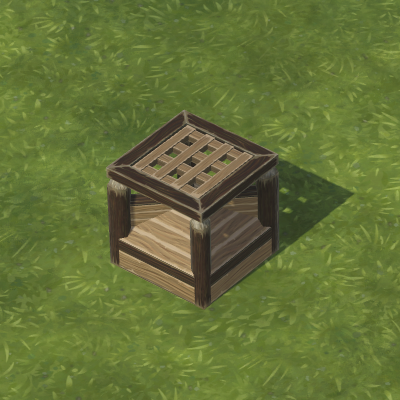 Dam immediately upstream prevents the upstream source from being fully drained; a dam can act as a buffer so the Fill Valve only draws down to a safer level (for example preventing levels below 0.50 m).
 - Use paired Depth Sensors and Fill Valves for smarter sluices: the sensor prevents the valve from drawing past the sensor’s threshold, preserving upstream water while keeping downstream channels filled.
- Fill Valves are visually useful in river engineering and landscaping and show well in dam-and-floodgate combinations to maintain wetted beds during droughts.
- The valve’s adjacency propagation option is useful for configuring long channels quickly; use it when you need uniform downstream depths across multiple valves.
Other entities of this type
- Advanced Breeding Pod
- Agora
- Aquatic Farmhouse
- Aquifer Drill
- Aquifer Drills
- Badwater Discharge
- Badwater Dome
- Badwater Pump
- Badwater Rig
- Bakery
- Banners
- Banners/Custom Banner Images
- Barrack
- Barriers
- Beaver Bust
- Beaver Statue
- Beehive
- Bell
- Bench
- Bot Assembler
- Bot Part Factory
- Brazier
- Breeding Pod
- Builder Flag (Obsolete)
... +162 (see sidebar for full list)