Refinery
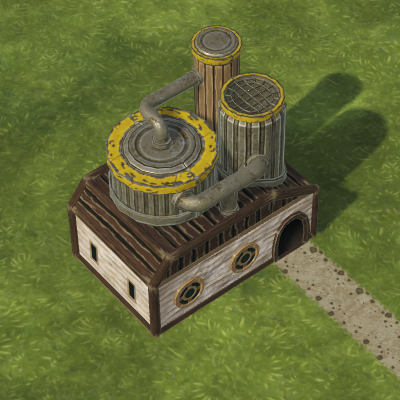
Overview
The Refinery is a production building that converts crops and organic goods into  Biofuel. It serves as the primary means of producing fuel for steam-powered machinery and vehicles, fitting into the colony’s resource chain between agriculture and energy-consuming buildings. The Refinery accepts several crop-based recipes and processes them into units of Biofuel over time, requiring assigned beavers to work at the building to complete each job.
The Refinery has four known recipes: carrots into Biofuel, potatoes into Biofuel, spadderdock into Biofuel, and a mixed recipe that combines one unit of an unspecified input plus two units of another to yield three Biofuel (listed in-game as a separate small-output recipe). Each recipe consumes a set amount of crop units and outputs a fixed number of Biofuel units when a work task completes. All recipes take the same amount of work time to process, so fuel throughput depends on both the fuel-per-recipe yield and the crop production rate feeding the Refinery.
Because work tasks are performed by individual beavers, worker condition and speed affect refinery throughput. A beaver with higher condition scores completes refinery tasks faster due to bonuses to Work Speed and Movement Speed at condition thresholds (for example, condition 0 grants a +45% Work Speed and +30% Movement Speed bonus; condition 1 grants +90% Work Speed and +60% Movement Speed). Assigning fit beavers to refine tasks increases total Biofuel produced per day.
Practical notes for use and optimization:
 Spadderdock yields the most Biofuel per crop tile, producing 3.125 Biofuel per tile per day based on its growth rate and recipe conversion; potatoes yield 2.5 and carrots 1.875 per tile per day. Use spadderdock where tile efficiency is critical.
- Because each recipe requires the same processing time, potatoes produce more fuel per Refinery work-hour when considering the fuel-per-unit and harvest rates; potatoes are therefore efficient when labor is the limiting factor.
- Locate Refineries near crop storage or fields to minimize travel time for beavers hauling inputs; shorter travel reduces idle time and increases effective throughput.
- Balance crop allocation between food needs and fuel production. Crops used for Biofuel are not available for direct consumption, so ensure agricultural planning accounts for both needs.
- Automate input supply where possible using storage and delivery chains so the Refinery has a steady queue of recipes and workers remain busy.
Other entities of this type
- Advanced Breeding Pod
- Agora
- Aquatic Farmhouse
- Aquifer Drill
- Aquifer Drills
- Badwater Discharge
- Badwater Dome
- Badwater Pump
- Badwater Rig
- Bakery
- Banners
- Banners/Custom Banner Images
- Barrack
- Barriers
- Beaver Bust
- Beaver Statue
- Beehive
- Bell
- Bench
- Bot Assembler
- Bot Part Factory
- Brazier
- Breeding Pod
- Builder Flag (Obsolete)
... +162 (see sidebar for full list)