Water Pump
Overview
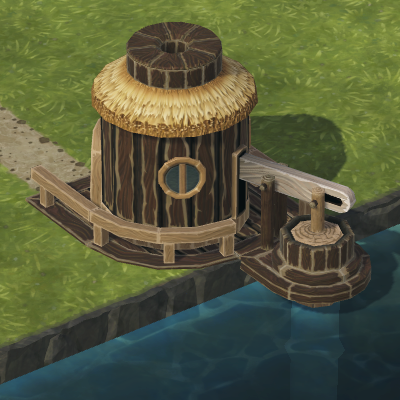
The Water Pump is a basic fluid-building used to move and produce surface water in Timberborn. It appears in two faction-specific variants: the  Folktails Water Pump and the
  Iron Teeth Deep
  Water Pump. Regular Water Pumps create drinkable surface water by producing flowing water from a water source and are visually themed per faction; the Folktails version pumps from a depth of 2, while the Iron Teeth version pumps from a depth of 6.
Mechanical Water Pumps are an advanced counterpart that move water between locations instead of creating potable water. Mechanical variants exist for both factions as well: the Folktails Mechanical Water Pump pumps from depth 4 and the Iron Teeth Deep Mechanical Water Pump from depth 6. Mechanical pumps cost more resources to build and do not produce drinkable water — they transfer water across the map and require explicit demand to be useful.
Practical details and usage notes:
- Water Pumps draw from nearby water sources to generate flowing water. Regular pumps convert the source into drinkable flow; mechanical pumps simply transfer non-potable water.
- Pumping depth determines how deep a pump can reach into a water body. Use deeper pumps (Iron Teeth variants) to exploit lower water levels or to reach deeper reservoirs.
- Flowing water created or moved by pumps continues to travel until it reaches the map edge. If flow reaches the map edge, it will flow off and de-spawn. Placing a water source tile at the map edge blocks flow from leaving the map at that location.
- Natural water sources only produce flow during temperate weather. During drought conditions these sources dry up and cease producing water, so pumps dependent on natural sources will stop working when the source is dry.
- Water sources have a configurable strength (up to 8.0 in standard maps). Mapmakers can set negative strength to make a source absorb water instead of generating it; pump placement should account for source strength and map settings.
- Mechanical Water Pumps require more resources to build (notably higher material costs) and have a consumption cost when operating; they are meant for bulk water transport and infrastructure rather than direct drinkable supply.
- Use regular Water Pumps to supply wells, reservoirs and drinking needs. Use Mechanical Water Pumps to circulate water, refill irrigation systems, or move large volumes between basins where drinkable status is not required.
Visually the Water Pump is categorized under water buildings and fluid pumps and is commonly placed on rivers or ponds to utilize existing surface water. When planning pump networks, account for pumping depth, seasonal drying of sources, and the inevitability of flow that reaches a map edge being lost.
Strategy guides covering this
Other entities of this type
- Advanced Breeding Pod
- Agora
- Aquatic Farmhouse
- Aquifer Drill
- Aquifer Drills
- Badwater Discharge
- Badwater Dome
- Badwater Pump
- Badwater Rig
- Bakery
- Banners
- Banners/Custom Banner Images
- Barrack
- Barriers
- Beaver Bust
- Beaver Statue
- Beehive
- Bell
- Bench
- Bot Assembler
- Bot Part Factory
- Brazier
- Breeding Pod
- Builder Flag (Obsolete)
... +162 (see sidebar for full list)