Beginner's Guide: Getting Started, Base, Mining & Early Boss Prep
Terraria is a 2D sandbox action-adventure where you start with almost nothing and must gather resources, build shelter, and improve equipment to survive, explore, and defeat bosses. This beginner guide covers the essential actions and systems you need to get started and make steady progress.
First steps: spawn, inventory, and controls
- On first spawn you appear at the world’s spawn point with starter tools: a Copper Shortsword (or equivalent), a Copper Pickaxe, and a Copper Axe (Journey characters get stronger starters). Open your inventory with the Inventory key to see your Hotbar (10 quick-use slots) and the crafting menu.
- Basic controls: move with WASD (or controller stick), jump with Space, left-click to use the selected hotbar item (attack/place), right-click to interact/talk/split stacks, and number keys or scroll wheel to switch hotbar slots. Bindings can be changed in Settings → Controls.
- Health is shown as red hearts (each = 20 health). All characters start with 100 health. Mana is blue stars (each = 20 mana), starting at 20. Health and mana can be increased by finding Life Crystals, Life Fruits, and Mana Crystals.
What to do on day one
- Collect wood by chopping trees with your Axe; wood is the fundamental building and crafting material.
- Kill easy surface enemies (slimes, zombies during night) to gather Gel, coins, and occasional items.
- Before night falls (night begins at in-game 19:30 / 7:30 PM), build a simple shelter: a sealed box with a door or platforms, at least one light source (torch) and a Work Bench (crafted from 10 wood) so you can craft improved tools and weapons. NPCs require a furnished, properly sized house with walls, a light source, a door, a table, and a chair to move in later.
- Place essential items in your hotbar: a weapon (melee or ranged), a pickaxe, blocks/platforms, torches or other light, ropes or grappling hook if available, and a healing potion.
Crafting and tools
- Crafting is context-sensitive and depends on materials in your inventory and nearby crafting stations. A Work Bench unlocks many early recipes (wooden sword, wooden platforms, etc.). Use an Anvil to craft metal tools and weapons once you have bars.
- Weapons: hold or click to use. Melee weapons like swords and spears are reliable early; ranged weapons (bows) require arrows. Accessories and armor greatly improve survivability.
- Tools: pickaxes mine blocks/ore, axes chop trees, and hammers alter placed furniture and walls. Upgrade them as you find better ores underground.
Building a safe base
- A basic safe house for the first night: complete rectangle or platform frame with no enemy spawn gaps, a door or platforms for entry, torches, a Work Bench, and a Chair/Table for NPC needs. Campfires and Heart Lanterns give passive healing buffs when you can make them.
- Secure spawn for events: certain invasions (Goblin Army,
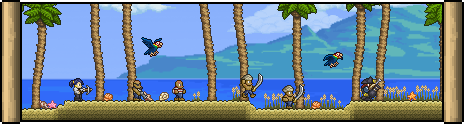
- Use platforms for doors that allow movement while preventing many enemy spawns.
Exploring and mining
- Surface exploration: look for biomes (Desert, Jungle, Snow, etc.) — each biome has unique resources, herbs, and chests.
- Mining: dig downward or follow caves. Deeper layers contain better ores and more dangerous monsters. Use Glowsticks, Flares, or light-producing equipment to see; Spelunker Potions highlight ore.
- Efficient mining tips: explosives are fast for breaking rock and exposing ore veins but cost money; manage your inventory by using Piggy Banks or selling unwanted loot to NPCs.
- Underground Cabins often contain Gold Chests with powerful early items like Hermes Boots,

Movement and mobility
- Early mobility items:

- Accessories can be combined and upgraded. Later you’ll obtain mounts, wings, and advanced boots for flight and resistance to liquids like lava.
- Minecarts can be used to travel Rapidly across tracks; booster and pressure plate tracks alter behavior. Tracks can be hammered to set open/closed/bump behaviors.
Combat basics and survivability
- Always carry a stack of the best healing potions you can reasonably afford/use. Natural health regeneration is slow; potions provide immediate bursts. Lesser and Greater Healing Potions exist; use according to your current stage.
- Prepare boss fights: craft an arena with platforms, good lighting, healing potions, buffs from food and potions, and movement aids. Learn each boss’s behaviors as you attempt them.
- Buffs and potions: many consumables help (


NPCs and early progression
- The Guide is the first NPC and offers crafting help. Other NPCs (


- The Dryad offers nature items and Purification Powder (pre-Hardmode) to remove Corruption/Crimson locally and sells Planter Boxes after certain bosses.
- The Angler gives fishing quests that reward money and useful items; fishing early is a reliable money source.
Herbs, potions, and crafting progression
- Gather herbs from surface biomes for potion crafting. Herb seeds are obtained by harvesting herbs when in bloom;

- Potions are vital for boss fights and exploration; stockpile seeds and grow herb farms to support sustained potion use.
Time, day/night, and world choices
- One in-game day lasts 24 minutes of real time. Day runs from 4:30 to 19:29 (15 minutes), night from 19:30 to 4:29 (9 minutes). Many early enemies are weaker by day; certain bosses and events require night.
- World creation choices:
- World Evil: Corruption or Crimson changes some loot and late-game progression but not essential for a first playthrough—pick whichever looks fun.
- World Size: Small = easier early travel; Medium and Large yield more resources and biomes. Choose based on desired game length.
- Difficulty modes: Classic (default) is recommended for first runs. Expert and Master increase enemy health/damage and add changes; Journey Mode gives creative powers and is beginner-friendly but requires Journey characters.
Quality-of-life and miscellaneous tips
- Always keep light sources (torches, mining helmet,
- Keep a good set of tools and at least one recall method (Magic Mirror,

- Save spare materials in chests to craft or sell later; manage inventory space by keeping commonly used items in the hotbar.
- Don’t worry about perfect decisions early—many mechanics have equivalents (Corruption vs Crimson, world seeds). Explore, experiment with building and crafting, and gradually expand your goals (NPC housing, exploring biomes, defeating specific bosses).
This outline covers the practical essentials you need to survive and thrive as a new Terraria player. Focus first on shelter, basic tools, mobility (boots / double jump), a light source, and simple armor/weapons; then explore caves, collect ores, upgrade equipment, and prepare for boss encounters.