Automation Guide: Belts, Cutters & Stackers
Automation ties together the factory: it moves, modifies, and composes shapes so your production lines produce the desired blueprints reliably. This page explains the core automation building behaviors and placement controls you'll use to route parts, split and join shapes, and keep structures stable.
Basic movement: Conveyor belt
Conveyor belts transport shapes horizontally and are the primary way to move parts between platforms and machines.
- Placement: Click-and-drag with the place-confirm key (default: left mouse button) to draw belts. While dragging, you can place and lock intermediate anchors to control the belt path before finalizing.
- Anchors: Press the "place anchor" hotkey (default: C) to add or remove anchors while placing a belt. Anchors let you fix corners and segments during placement so the belt follows an exact route.
Conveyor belts obey gravity and structural support rules described below (see Structural support and falling).
Splitting and trimming: Cutter
The cutter splits shapes vertically into two halves.
- Output orientation: The cutter outputs the eastern half of the input at its main output and the western half at its secondary output.
- Mirrors: All mirrored or rotated versions of the cutter operate the same way relative to their orientation (i.e., the side designated as "main" always outputs the half on its eastern side in world-space).
Use cutters when you need to remove a side of a composite shape or to generate two complementary halves for downstream processing.
Stacking and composition: Stacker
The stacker composes shapes by taking two inputs and stacking them.
- Behavior: The stacker takes the shape received at its top input and places it on top of the shape received at its bottom input, then outputs the combined result.
- Use cases: Build larger, multi-layer shapes by feeding pre-cut parts or by stacking identical items to create multi-layered templates required for advanced blueprints.
Stackers are the main building block for vertical composition where conveyor routing alone cannot achieve the required overlap.
Structural support and falling (Process / stability)
Factory pieces are subject to a simple structural rule: layers are processed from bottom to top and contiguous groups of horizontally connected parts are evaluated for vertical support.
- Group formation: For each layer (starting from the bottom), the game splits that layer into groups of horizontally connected parts.
- Support check: If a group has no vertical support beneath it (no parts directly under any part in the group), the entire group begins to fall.
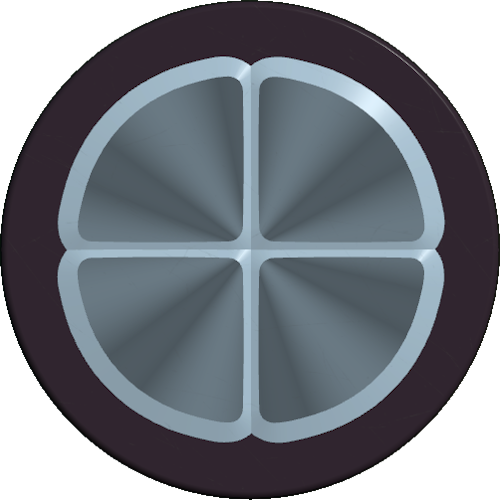
- Falling stops: Groups fall until at least one of their parts is directly above another part, restoring support.
Design conveyors, machines, and stacked assemblies with continuous support in mind: unsupported spans will collapse, possibly destroying crystals and disconnecting networks.
Design tips and common patterns
- Plan anchor points when laying long belt runs to force exact routing around machines and to avoid accidental gaps that could create unsupported groups.
- Use cutters early to create halves that feed parallel lines; this simplifies downstream stacking and alignment.
- Combine stackers and cutters to assemble complex multi-layer blueprints: cut into pieces, align on parallel belts, then stack in the required order.
- Keep vertical support continuous beneath conveyors and machines that form a layer. If you need an overhang, provide at least one supporting column beneath the run to prevent the group from falling.
- Remember orientation: cutter outputs are tied to world directions (east/west) relative to the machine's orientation; plan machine rotations accordingly so outputs feed intended belts or inputs.
This covers the essential automation mechanics for moving, splitting, and composing shapes while maintaining structural integrity in your factory.