unit-aegires
Overview
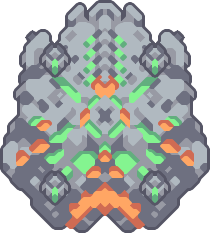 Aegires is a Tier 4 mobile support unit that combines dense point-defense weaponry with a short-range energy field that both damages enemy projectiles/blocks and heals allied units. It was added in Build 127 and has undergone several balance changes: its movement speed, item capacity, weapon fire rate and damage, field range, and the field's healing percentage have been modified across builds; notable final adjustments include a 1.5% energy-field healing percentage and a -50% same-type healing penalty that reduces how much Aegires heal other Aegires. Aegires has very high health for its tier (listed at 12,000), making it one of the bulkiest Tier 4 units.
The unit mounts multiple point-defense weapons (effectively grouped as two identical sets) that fire rapidly at incoming projectiles and bullets; each weapon has a high fire rate (final builds show 7.5 shots/sec per mount) and deals 30 damage to projectiles. Its energy field has a short range and applies both a damage component to blocks and projectiles and a healing component to allied units inside the field. Healing is applied as a percentage of the target's max health (similar in behavior to a  Mend Projector), which means high-health Tier 5 units gain the most absolute HP per tick from the field. The field also inflicts a status that reduces enemy fire rate to roughly 60% of normal while inside it, which can significantly blunt sustained DPS.
In practical use, Aegires excels as a watery or mobile support platform: it can be carried by 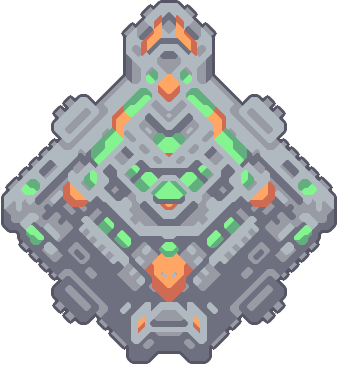 Oct units to reposition across land and is especially effective on maps with deep water where turrets cannot be placed. Its strengths include strong survivability, powerful local projectile denial via point defense, percent-based healing that favors large high-HP units, and the field’s fire-rate-slowing effect that helps whole formations survive prolonged engagements. Because its healing is percentage-based, two Aegires can out-heal high-DPS turrets on large targets in some scenarios (examples cited compare dual Aegires healing an
 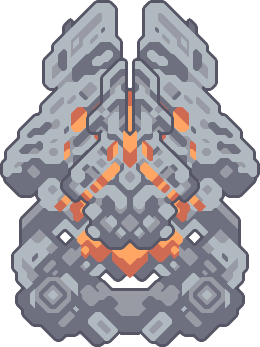 Omura faster than a
  Foreshadow’s effective damage), though the same-type healing penalty prevents exponential self-healing among stacked Aegires.
Counterplay and deployment notes:
- The energy field can rapidly destroy fragile conveyor and power-network blocks if left unblocked;
 Plastanium Walls can block the field and protect fragile infrastructure, while an outer layer of
  Thorium Walls can soak up incoming bullets so the Plastanium layer only receives laser/energy damage.
 - Projectile-heavy long-range weapons like
 Ripple are less effective because the Aegires’ point defense can intercept many projectiles; non-projectile turrets (for example, high-impact beam or explosive turrets) can be used to bypass point defense.
 - The field’s healing is percentage-based, so low-max-health blocks (Overdrive Dome, small repair units) receive less absolute HP per tick and remain vulnerable even when inside the field.
- Repairing units (Poly,
 Mega) and other fragile supports can be killed by the field unless the field is blocked or they are kept out of its destructive effects.
 - When paired offensively with other units (notably the
 Sei), the combination can be dangerous: the Sei’s propensity to breach defenses and the Aegires’ survivability/healing make coordinated pushes effective; however, focus-firing the Sei first is often necessary because it enables field infiltration.
 - Avoid stacking many Aegires solely for mutual healing: the same-type healing penalty halves the effectiveness of Aegires healing other Aegires, so large stacks do not produce an unstoppable self-healing bubble.
Trivia: the unit’s name references the nudibranch genus Aegires. The Aegires’ percent-based healing makes it particularly impactful on very high-HP units such as 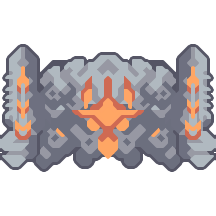 Reign and Oct, which receive a larger absolute heal per zap than lower-HP allies.