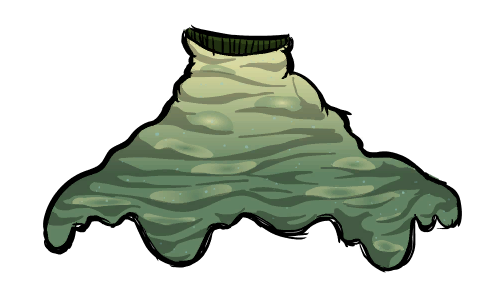
Polluted Water with 20000 Food Poisoning per kg: Average 3 kg/s @ 30°C
Decor
10
Decor radius
2
Overview
A Polluted Water Vent is a geyser that periodically releases Polluted Water, providing a steady source of liquid that is especially useful in the early and mid game. Its output is already warm enough for many base systems, and it can be turned into either clean Water or used directly in several farm and industrial chains. Unlike many other water sources, it also creates a contamination management problem: both the vent and the Polluted Water it produces can spread Food Poisoning germs if handled carelessly.
The vent’s output can be used in several ways. Polluted Water can be fed directly to Thimble Reed, and in the DLC it can also support other plants that require Polluted Water, including Bog Bucket. If you convert it to Water with a Water Sieve, it can then be used for ordinary irrigation and for Oxygen production through Electrolyzers. It can also serve as an early coolant for a Metal Refinery. Because the vent’s output is water-positive in practical terms only after treatment and storage, many bases route it into processing and germ-killing systems before adding it to the main supply.
A common setup is to send the Polluted Water through a Water Sieve, store the result in a Liquid Reservoir, and then remove germs before using it elsewhere. In the base game, Chlorine can be used to disinfect the cleaned Water; in the DLC, radiation is also a practical option, with a Shine Bug or Radiation Lamp serving as the source. This is especially important because germs survive the conversion from Polluted Water to Water. If the treated Water is used in a Water Cooler, Espresso Machine, Juicer, Soda Fountain, or for food ingredients such as Mush Bars, Duplicants can become infected. By contrast, using germy Polluted Water directly on plants does not contaminate the harvested food in the same way, so direct irrigation is often safer than feeding it into drinking or cooking systems.
Polluted Water itself also emits Polluted Oxygen, even in a vacuum. Emission stops when the pressure above it reaches about 1.8 kg/tile, and it only releases upward. A full exposed tile produces roughly 30 kg per cycle on average, though the output is irregular because the emission uses a low-probability process. If the Polluted Water is stored in a Liquid Reservoir, it does not emit Polluted Oxygen at all, which makes reservoirs an effective way to stockpile it without losing mass or filling the area with gas. If you want to maximize Polluted Oxygen production, spread the liquid across multiple tiles instead of stacking it into one mass.
Some useful handling notes:
Polluted Water is a good source for producing Oxygen once it is sieved into clean Water.
Germs in the water do not spread through inhalation, so feeding cleaned water to Electrolyzers is safe for Duplicants.
Polluted Water can be used as a by-product source for industrial loops, especially when paired with liquid storage and temperature control.
Because the vent output is already at a workable temperature, it is often easier to use than colder geyser outputs for early infrastructure.
Overall, Polluted Water Vents are valuable because they provide a renewable liquid that can support farms, Oxygen production, and cooling, but they reward careful plumbing and contamination control.