Agriculture Guide: Farming & Food Production Tips
Agriculture in Oxygen Not Included covers growing plants, farming industrial plants, and ranching critters that interact with farms. Properly designed agriculture supplies food, cooking ingredients, fertilizer, utility resources (dirt, slime, bleach stone, lumber, etc.), and specialized materials (ethanol, nectar, gas conversion plants). This page summarizes core mechanics, plant and ranching categories, common setups and practical tips for stable production.
Core mechanics and requirements
- Plants share a growth system: each has a temperature range, atmospheric/pressure needs, illumination preference, irrigation and/or fertilizer requirements. If any requirement is unmet the plant becomes stifled and stops growing.
- Most plants require at least some atmospheric pressure to grow (commonly ~150 g up to 10 kg); some (




- Domestic (planted) crops grow much faster than wild (wild = ~4× slower) and often require regular fertilizer (









- Hydroponic Farms accept liquid irrigation directly; Planter Boxes and Farm Tiles require resources delivered to the tile. Farm Tiles have no decor penalty and are compact for inline farms.
- Plants auto-harvest themselves 4 cycles after reaching full maturity; some plants yield harvests that then rot if not processed or stored.
Illumination and light-sensitive plants
- Many plants are indifferent to light; a few require or forbid light:

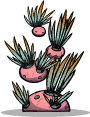
- Dusk Caps and other dark-preferring mushrooms (Spaced Out! DLC plants) require darkness (even 1 lux halts growth).
- Mutations or DLC effects (Bountiful, Leafy, Exuberant, etc.) modify illumination requirements for affected plants.
- Sun Lamps, Ceiling Lights, or arrays of lights can be used; be mindful of heat produced by lamps and ceiling lights.
Fertilizers and inputs
- Common fertilizers and irrigation:



- Fertilizer Synthesizer can convert Polluted Water + Dirt + Phosphorite into Fertilizer for plants.
- Some critter farms supply fertilizer inputs (


Food plants — quick references and roles





Utility and industrial plants


Ranching and plant synergy
- Many critters depend on or benefit farms and vice versa:
- Pips eat Arbor/

- Pufts consume Polluted Oxygen and excrete Slime (95% efficiency); slime feeds Dusk Caps or is distilled into Algae. Squeaky Puft (chlorine variant) produces Bleach Stone to support Waterweed.
- Puft Prince and breeding mechanics let you influence egg types (Dense, Squeaky, etc.).
- Sweetles produce Sucrose (from Sulfur) and Grubgrubs convert sucrose into Mud when fed — combining Sweetles + Grubgrubs is the efficient way to turn Sulfur into Mud and ultimately into Grubfruit Preserve / food chains.

- Shove Voles, Pokeshells, Hatches and other critters each have specialized diets and outputs (meat, eggs, dirt, coal) — plan ranches around available plant/ore resources.
- Pips eat Arbor/
Common farm designs and tips
- Separate farms by plant requirements: isolate mushroom farms to collect CO2, isolate cold farms (
- Use Hydroponic Farms when liquid delivery and temperature control are manageable; they simplify irrigation but add piping complexity and heat risks.
- Use Planter Boxes or Farm Tiles for simpler early farms; Farm Tiles are compact and avoid planter decor penalties.
- Greenhouse room + Farm Station: placing a Farm Station in the greenhouse lets duplicants craft Micronutrient Fertilizer and tend plants even if the Farm Station is the only building in that room. Micronutrient Fertilizer speeds domestic growth — note only one can be made at a time.
- Stagger planting times to avoid synchronized harvests that cause bulk spoilage (important for long-cycle crops like Grubfruit).
- Store harvested food in Refrigerators / Ration Boxes and prepare long-life food (
- Manage light and heat: lamps produce heat; for light-hungry plants on the surface prefer sunlight or Sun Lamps with light sensors to limit runtime and conserve power.
- Use critter-based loops for sustainable inputs:
Advanced strategies
- Convert byproducts to food or inputs via multi-step chains: e.g.,


- Use Oxyfern farms in CO2-heavy biomes to both produce oxygen and clean the atmosphere, pairing with plants that prefer CO2 (Dusk Caps in CO2 pools).

- Use arbor tree farms and ethanol distillers to generate ethanol fuel and lumber;
Practical production numbers and ratios (design guidance)
- Many plants list specific daily or cycle resource needs (e.g.,
- Ranch capacities: stable tiles are sized by critter type (most critters need 12 tiles per critter; Pufts and some variants require 16 tiles). A maximally sized stable supports up to 8 non-
- Use critter-to-plant ratios from detailed species guides when planning sustainable loops (for example, Sweetle:Grubgrub professions or Pip:Arbor Tree feeding ratios). These vary by critter and plant domestic/wild status.
Common pitfalls
- Forgetting specific liquid/soil requirements will stifle plants (e.g.,
- Lighting a dark-mandatory crop or letting even 1 lux reach a dark-preferring plant will stop growth (mushrooms).
- Heat from lamps, refrigerators, distillers, and research buildings can overheat farms—always plan heat exchange and insulation.
- Clumping plantings leads to harvest spikes and spoilage — stagger and cook/preserve surpluses.
- Ranch overcrowding causes glum/overcrowded debuffs and reduces production; respect critter tile requirements.
This covers the essential concepts and practical advice to design effective agriculture in Oxygen Not Included. For any specific plant or critter build, follow the plant’s detailed page for exact input numbers and precise growth timings when laying out production chains.