Mechanized Airlock

Overview
The Mechanized Airlock is an upgrade to the 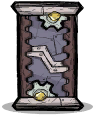
When closed, it counts as a floor tile and can support buildings; when open, it does not. Duplicants and land critters can move across it whether it is open or closed, which makes it useful in base layouts where you want traffic control without blocking movement. Because it can be automated, it is especially valuable in high-traffic areas or in places where a manual door would slow Duplicant pathing. Its quick opening speed can also help in unbreathable areas, reducing the time a Duplicant spends waiting at a sealed doorway.
Mechanized Airlocks have a single automation input. A green signal opens the door, while a red signal closes and locks it. In practice, this makes them useful for turning other buildings on and off indirectly: if a building is placed above a Mechanized Airlock, closing the door can disable it and opening the door can re-enable it without Duplicant intervention. This is particularly handy for buildings that lack an automation input of their own.
They also have several thermal and fluid-management applications. When open, a Mechanized Airlock does not transfer heat if no gas or liquid occupies the tile, so an automated door can be used as a heat switch between two solid areas. For this purpose, 


- Manual Airlocks and Mechanized Airlocks do not take damage from high liquid pressure, making them useful alongside Airflow Tiles for large liquid reservoirs or liquid compressors.
- Despite the name, the Mechanized Airlock is not a true airlock on its own; gases and liquids pass through when it opens. A proper airlock requires two doors and pumps.
- For pump-based door systems, keeping the doors unpowered and moving slowly helps reduce leakage, because pumps have more time to catch incoming gas.
- Mechanized Airlocks can be used in sequencer-based builds to push gases, liquids, and even items, allowing compression beyond normal vent limits. If there is nowhere for the material to go, it can be destroyed.
- Reliable automation timing matters: on Fast simulation speed, a green pulse of about 0.4 s reliably opens the door, a red pulse of about 0.6 s reliably closes it, and stable oscillation falls around 1.4 s or longer. For critical builds, adding extra timing margin improves reliability.
There are also some notable edge cases. If a Mechanized Airlock is placed in space, it shows the space exposure tooltip even though it does not leak liquid or gas when opened. If a door is sealed by solid tiles in certain configurations, closing it can cause trapped substances to disappear, which can be used to destroy unwanted gas or liquid. In the same vein, improperly blocked doors can lose fluids during closure, so compression builds that rely on extreme densities are not always safe.
References to this (15)
- buildingAnti Entropy Thermo-Nullifier
- buildingConveyor Loader
- buildingDecor
- buildingGas Reservoir
- buildingInsulated Door
- buildingLiquid Reservoir
- buildingManual Airlock
- buildingRocket Control Station
- buildingSecurity Door
- buildingSweepy's Dock
- critterEgg
- elementMagma
- elementRegolith
- elementUranium Ore
- geyserVolcano
Other entities of this type
- [DEPRECATED] Steam Turbine
- Acoustic Art Panel
- Aero Pot
- Airborne Critter Bait
- Airborne Critter Condo
- Airborne Critter Lure
- Airborne Critter Trap
- Airflow Tile
- Algae Distiller
- Algae Terrarium
- Amber Fossil
- Anatomy Poster
- Ancient Specimen
- AND Gate
- Anti Entropy Thermo-Nullifier
- Apothecary
- Arcade Cabinet
- Artifact Analysis Station
- Artifact Transport Module
- Atmo Sensor
- Atmo Suit Checkpoint
- Atmo Suit Dock
- Atmo Switch
- Auto-Sweeper
... +534 (see sidebar for full list)