agriculture
Agriculture is the foundation of food security, forestry output, and several supporting industries in Captain of Industry. It starts with simple rain-fed farms and expands into irrigated production, greenhouses, livestock, tree management, and fertilizer systems.
Core farming
Farm
The basic Farm allows growing various crops and is used for food production. It depends on rain only, so its water supply comes from rainfall unless it is upgraded to accept an external source.
basic_farming
Basic farming is the simplest potato production. It is entirely dependent on rain.
Crop types
Different farm unlocks allow specific crops:
- vegetables_farming: grow and harvest vegetables in farms
- corn_farming: grow and harvest corn in farms
- fruit: grow and harvest fruit in greenhouses
Greenhouse
A Greenhouse has increased crop yield compared to the basic farm. Crops also require extra water and fertility. It is the production building for fruit and is the agricultural option when higher output justifies higher input demand.
Irrigated farm
An Irrigated farm can be connected to a source of water or fertilizer. It is the upgraded farm type for managing agriculture with external supply lines.
Water and rainfall
Agriculture is tightly linked to rainfall and water logistics.
- Groundwater reserves are finite but regenerate slowly through rainfall.
- Groundwater regeneration scales with reservoir capacity and rain intensity.
- A Rainwater Harvester collects water directly from rainfall.
- A Farm also stores rainwater in its soil buffer and regenerates water from rainfall.
This makes weather and map conditions important for early agriculture, especially before external water infrastructure is established.
Fertility, fertilizers, and crop control
Fertilizers

There are three fertilizer types with different fertility caps:


The farm menu has a green slider that sets the desired fertility. Higher fertility settings require more fertilizer input, and keeping fertility above 100% also requires compensating for natural replenishment.
crop_yield
Crop yield modifiers increase crop yield but also increase crop water consumption.
farming_boost
Farming boost increases farm yield but also increases water demand.
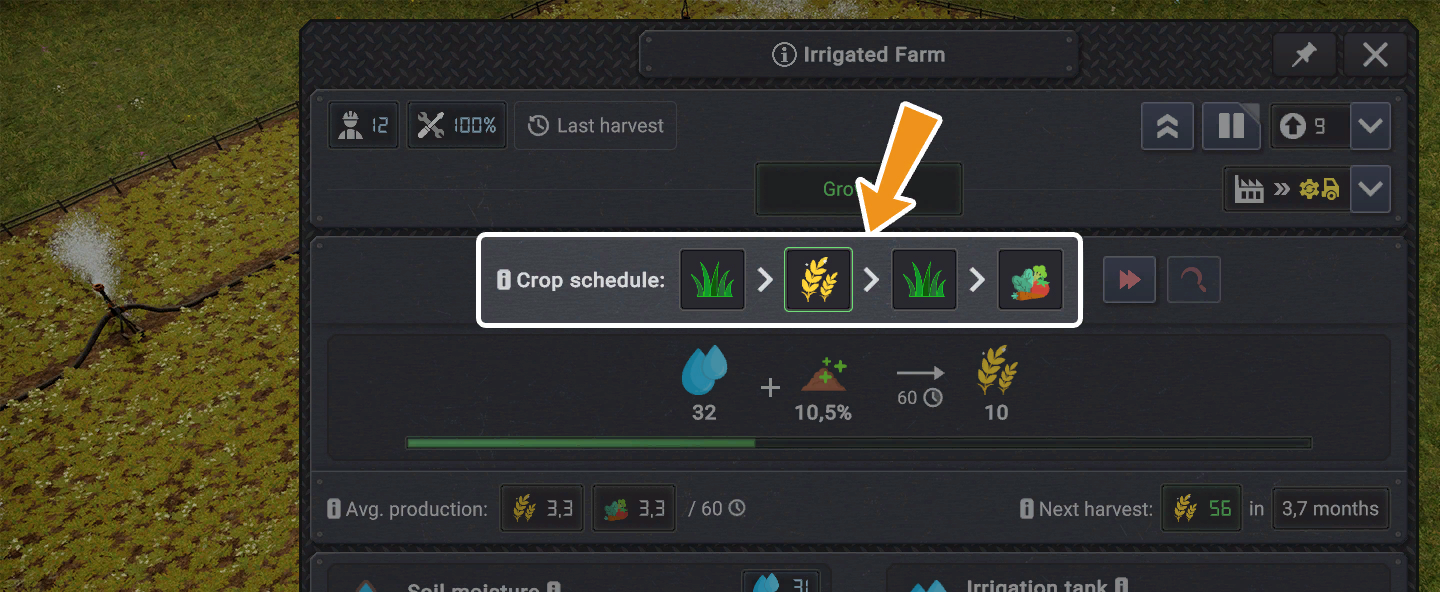
crop_rotation
Livestock
chicken_farm

Forestry and wood production
Agriculture in Captain of Industry also includes managed wood production.
Forestry Control Tower
The Forestry Control Tower assigns tree planters and tree harvesters to designated forestry areas. Only designated forestry areas within the tower’s influence can be used.
Harvesting Options
The Forestry Control Tower has Harvesting Options that control how large trees must be before being cut:
- 100%: standard option, maximizes harvested wood per tree
- 80%
- 60%
- 40%
Lower harvesting thresholds reduce the time from planting to harvest, but require more planted area to produce the same wood output.
Tree Planter
A Tree Planter is a machine for planting trees. It needs access to saplings.
Organic processing and food chains
biomass_collection
Biomass collection gathers organic waste, usually food scraps, from the attached settlement. If the settlement does not have this module, organic waste goes into general waste.
anaerobic_digester
An Anaerobic Digester uses microorganisms to break down biodegradable material in the absence of oxygen to produce fuels and fertilizer.
baking_unit
A Baking Unit bakes organic products such as bread.
food_market
A Food Market provides food to the attached settlement. Each settlement needs at least one food market or the population will starve.
food_market_ii
Food Market II also provides food to the attached settlement, but it can store 2 kinds of food products.
Practical agricultural flow
A strong agricultural setup usually develops in layers:
- start with rain-fed farming
- upgrade to irrigated farming or greenhouses when water and fertility control are needed
- use fertilizers to raise fertility and support higher yields
- add crop rotation to improve farm output
- expand into chicken farms for mixed food production
- connect settlements to food markets to prevent starvation
- route organic waste into biomass collection and anaerobic digestion to close the loop on food and fertilizer
The result is a system where farms, livestock, forestry, and waste processing support each other instead of competing for resources.
Pages featured in this guide
- researchBasic farming
- researchCorn farming
- researchCrop rotation
- researchChicken farm
- buildingIrrigated Farm
- buildingFarm
- research+ Crop yield
- researchFruit
- researchGreenhouse
- researchVegetables farming
- vehicleTree planter
- buildingAnaerobic digester
- buildingBaking unit
- buildingForestry control tower
- buildingFood market
- buildingBiomass collection